Loading...
Graphene Oxide Generic PBK model in mice

The model applied here is an implementation of a perfusion-limited physiologically based kinetic (PBK) model describing the biodistribution of Graphene Oxide (GO) in mice. It was developed as part of the 2D materials CHIASMA demo-case, building on experimental biodistribution data and physiological parameters available in the literature and PK-Sim database.
Graphene Oxide is a two-dimensional nanomaterial composed of layered carbon sheets arranged in a honeycomb lattice, enriched with oxygen-containing functional groups such as hydroxyl (-OH) and carboxyl (-COOH) (Magne et al., 2021). These features confer exceptional physicochemical properties that have positioned GO as a promising material for biomedical and energy applications. However, its biodistribution and systemic fate are highly dependent on its physicochemical characteristics—size, surface chemistry, agglomeration state, and functionalization—as well as the route of exposure (oral, inhalation, dermal, or parenteral). Consequently, the model was designed to capture how these determinants influence GO disposition across biological systems.
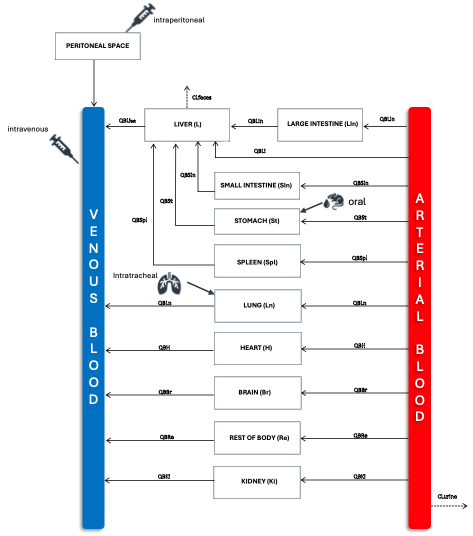
The developed PBK model represents GO distribution across major organs, including blood, liver, kidney, stomach, small and large intestine, lung, spleen, heart, and brain, with an additional “Rest of Body” (RoB) compartment encompassing all remaining tissues. All compartments are interconnected via arterial and venous blood flows, representing the systemic circulation. The model structure and flow scheme are shown below. The model equations describe the uptake, distribution, and clearance of GO under various exposure conditions (intravenous, oral, intratracheal, and intraperitoneal). GO uptake in each organ compartment is governed by tissue:blood partition coefficients and perfusion-limited kinetics. As an initial step, a deterministic parameter estimation was conducted to derive organ-specific partition coefficients, absorption, and clearance rates by simultaneously fitting the model to multiple experimental datasets. In this version, the same set of chemical-specific parameters was applied across GO types and exposure routes to ensure mechanistic consistency. For each exposure scenario, total organ concentrations were computed as the ratio of the GO amount in the tissue to the corresponding organ volume. The model output includes predicted time courses of GO concentrations or masses in individual organs and blood, enabling direct comparison with published biodistribution data.This PBK model provides a quantitative framework for assessing the fate and systemic behaviour of GO in vivo and can serve as a foundation for extending modelling approaches to other nanomaterials with comparable physicochemical characteristics.
The R implementation of the model is available through the Jaqpot platform and in an open-access GitHub repository. This repository hosts multiple published PBK models for various substances and organisms, supporting transparent reuse and further development within the nano-PBK modelling community.